Solo exhibition by Gábor Kristóf at Kisterem Gallery, Budapest. 2026 September 9 – October 9
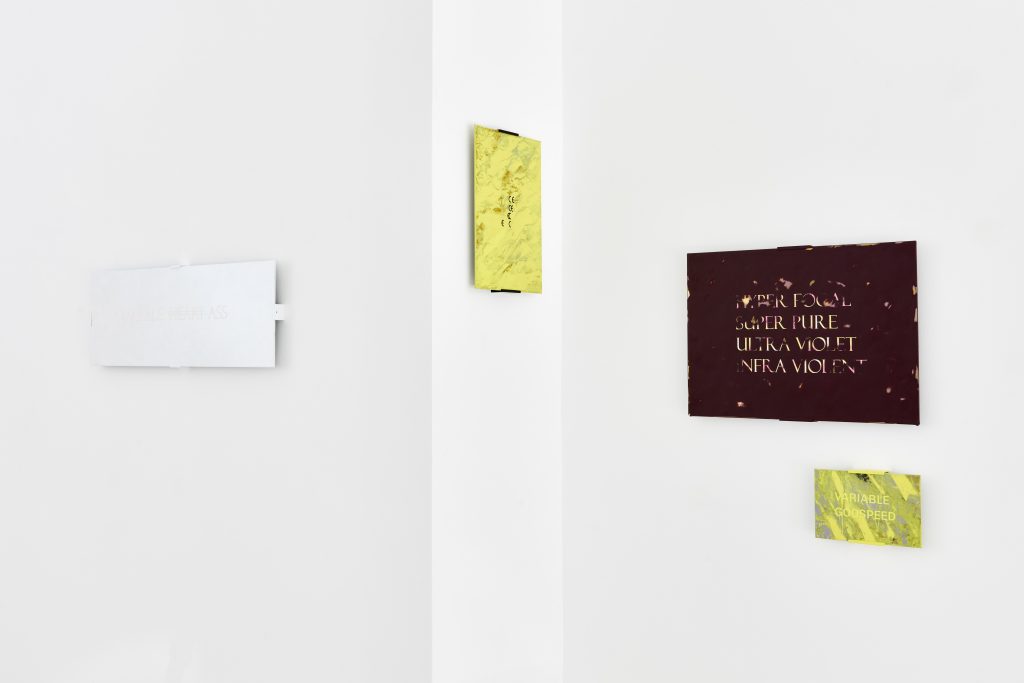
Gábor Kristóf’s third solo exhibition at Kisterem explores the abstract perception of time, the tension between collective and individual memory, and the persistent, often imperceptible ways in which globalisation shapes identity. The artist’s recent playful, installation-based and often collaborative artistic practices are replaced by a more introspective, solely text-based body of work, reduced to the strict format of the memorial plaque.
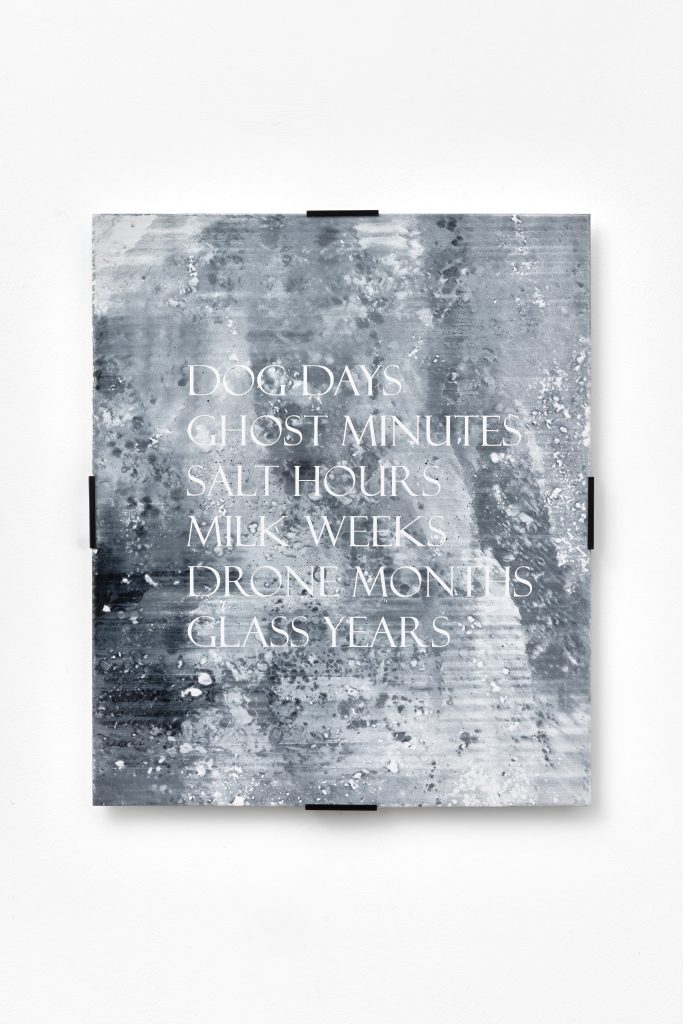
The marble plaques of GHOST MINUTES – SALT HOURS – FORDITE DREAMS synthesise notes accumulated by Kristóf over recent years with his research into the industrial technology of powder coating and the cultural history of the RAL colour standard. The resulting fordite, a synthetic stone-like material, together with the text inscribed upon it, assumes the character of an objective declaration within the exhibition space, drawing on the inherently public nature of the memorial plaque as a medium. Fragments drawn from Kristóf’s subjective reality and speculative compounds formed from everyday elements of consumer society are first fired onto steel plates and then placed within a metaphorical „public space”, where they hover in a fictional, synthetic spatiotemporal reality shared by artist and viewer.
FORDITE
Since the establishment of Ral5050 in 2023, Kristóf Gábor’s visual practice has been fundamentally shaped by an applied approach to art-making. The two basic components of powder coating technology—the metal substrate and the electrostatically adhered synthetic colour layer—define the formal and material framework upon which Kristóf’s conceptual practice is built.
A recurring motif throughout the exhibition is fordite, also known as Detroit agate. Originally a peculiar by-product of the boom of the American automotive industry in the 1950s, the material has since acquired an independent aesthetic and material value, becoming an almost mineral-like formation in its own right. Fordite consists of compacted layers that accumulate during the hand-painting of automobiles. Over time, thick, stratified masses form in industrial paint booths and curing ovens; once removed, these are further solidified through heat treatment. When worked and polished, the material reveals a distinctive pattern reminiscent of marble, in which the traces of the colours and layers once used become simultaneously visible. The symbolism of fordite thus emerges in Kristóf’s striking memorial plaques as a synthetic trace of the Anthropocene, an abstract perception of the stratification—and occasional disruption—of time, and a personal raster through which thoughts and perception become petrified. The surface qualities and colour ranges of the plaques shift between matte and polished, glossy and raised, homogeneous and enigmatic.
EPITAPH
And yet what we see in the exhibition space is neither objective reality nor a universally valid declaration, but simply the artist’s subjective semiotics of culture. These are so-called linguistic fossils, whose elements nevertheless appear uncannily familiar, humorous, or simply like a gag to an individual socialised within the consumer society of global capitalism and liberal democracy. The trick lies in translating visual content into text, thereby expanding the horizon of meaning of the represented subject matter indefinitely, or reducing it to zero for those whose household does not contain the air fryer, that cultural symbol of contemporary culinary culture purportedly capable of dissolving social class distinctions. In a world where the universal and the material are subject to continual accumulation, imagination itself becomes standardised, and a well-timed joke inevitably lands.
Yet for anyone attempting to interpret Kristóf’s latest works exclusively through the language of fine and applied art, the exhibition presents a challenge. However reluctant the artist may be to call himself an author—as the tradition of text-based and conceptual art has repeatedly demonstrated (see Jenny Holzer, Liam Gillick or Ed Ruscha)—some kind of poetic experiment nevertheless lies at the heart of the exhibition. From this perspective, it would be tempting to read the lines on Kristóf’s plaques as epitaphs to Fukuyama’s The End of History and the Last Man: funerary poems bidding farewell to a culture.
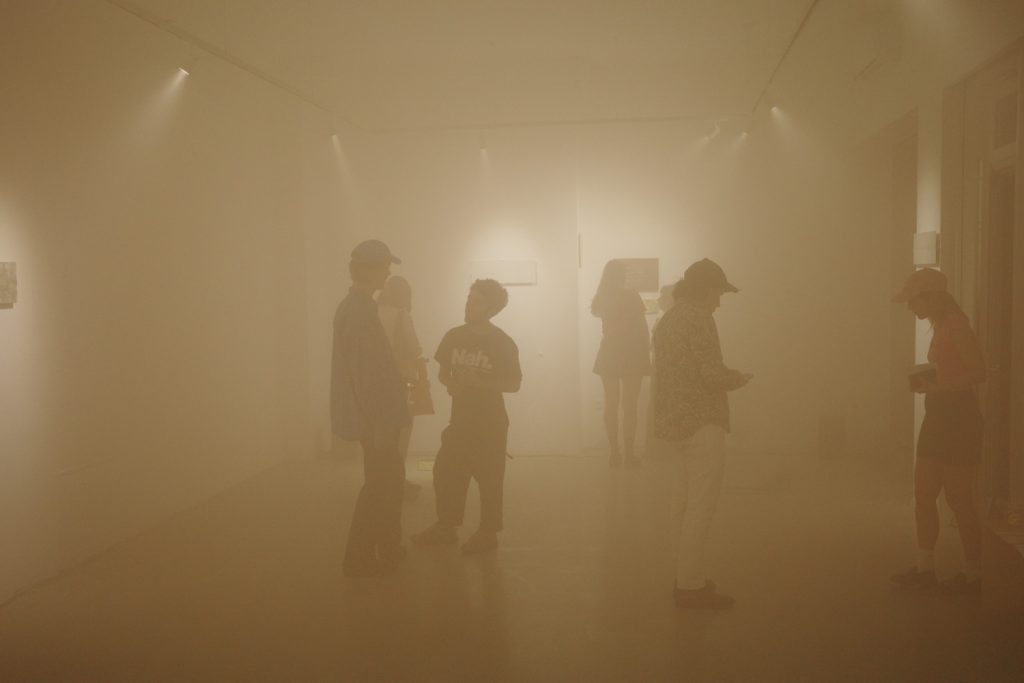
PUBLIC SPACE
Capitalism is not merely an economic system but a cultural environment that delineates the boundaries between reality and imagination. Through the gallery window, an imagined street simultaneously emerges: our randomly unfolding yet inevitably rule-bound visual framework, alongside the consciousness of our capitalist realism reflected in the glass. The exhibition space becomes a vaporisation of this sense of reality, in which social requisites, ingrained images and meanings seem gradually to lose their concrete historical references, only to return with new roots as standardised signs and colours.
Kristóf’s Gothic typology emerges as a figure of absence, a configuration of desire, and thus acquires critical potential. The political unconscious permeates the work as a destabilising force, drawing attention to the tension between the meaning of the artistic product and the “repressed and buried reality” of history. The standardising signs that recur throughout the works—the European Union, the CE marking, ISO standards and the RAL colour system—become a common language of global culture. The trompe-l’œil quality of the marble, meanwhile, appears as their material counterpart, rewriting the traditional symbol of wealth and eternity as an industrial, synthetic materiality. GHOST MINUTES – SALT HOURS – FORDITE DREAMS simultaneously points to the conformist promise of universality embedded in a standardised world and to its unsettling, uncanny consequence: while everything becomes increasingly recognisable and comparable, our own imagination, too, is increasingly constructed from the very same signs…
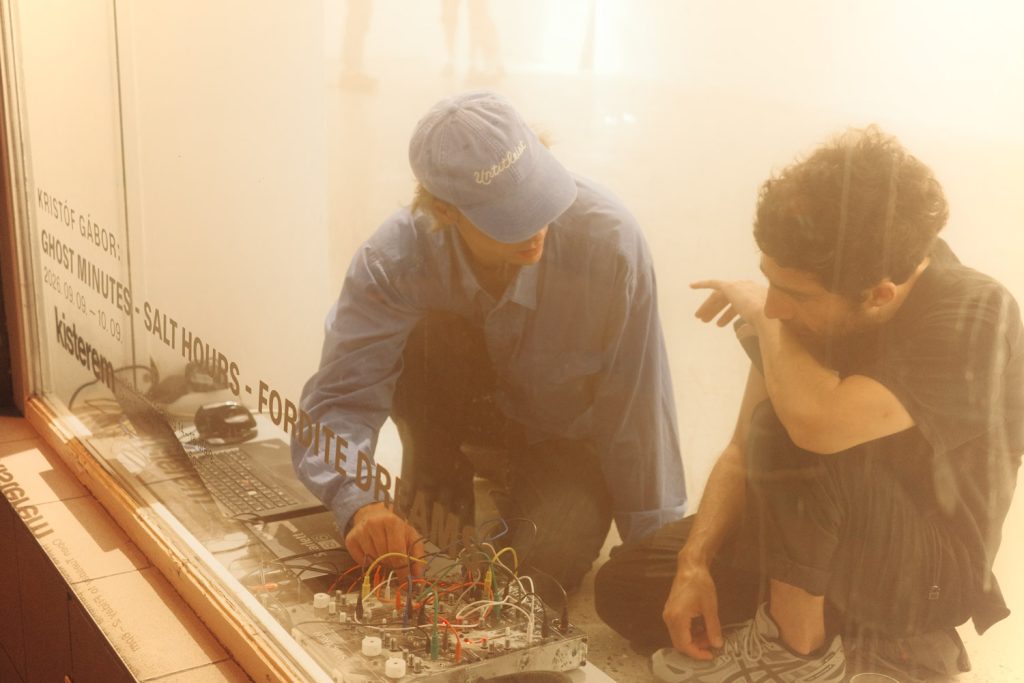
Opening performance: The Stanley Maneuver
Photos: Dávid Biró